anda bisa download materi di sini PDF
Frames of Reference and Newton’s Laws
The Laws of Physics are the same in all inertial frames of reference.
We shall see that many surprising consequences follow from this innocuous looking statement. Let us first, however, briefly review Newton’s mechanics in terms of frames of reference.
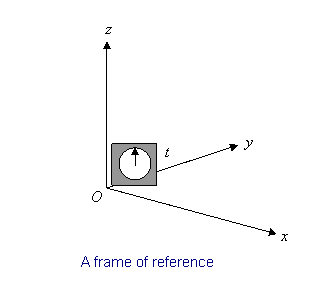
A point in space is specified by its three coordinates (x, y, z) and an “event” like, say, a little explosion, by a place and time: (x, y, z, t).
An inertial frame is defined as one in which Newton’s law of inertia holds—that is, any body which isn’t being acted on by an outside force stays at rest if it is initially at rest, or continues to move at a constant velocity if that’s what it was doing to begin with. An example of a non-inertial frame is a rotating frame, such as a carousel.
The “laws of physics” we shall consider first are those of Newtonian mechanics, as expressed by Newton’s Laws of Motion, with gravitational forces and also contact forces from objects pushing against each other. For example, knowing the universal gravitational constant from experiment (and the masses involved), it is possible from Newton’s Second Law,
force = mass × acceleration,
to predict future planetary motions with great accuracy. Suppose we know from experiment that these laws of mechanics are true in one frame of reference. How do they look in another frame, moving with respect to the first frame? To find out, we have to figure out how to get from position, velocity and acceleration in one frame to the corresponding quantities in the second frame.
Obviously, the two frames must have a constant relative velocity, otherwise the law of inertia won’t hold in both of them. Let’s choose the coordinates so that this velocity is along the x-axis of both of them.
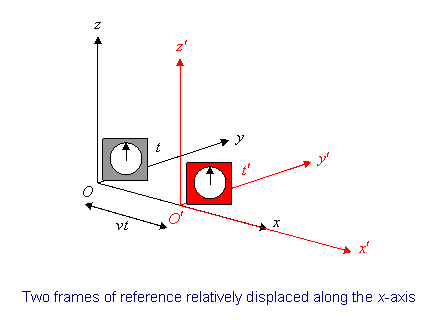
Suppose S′ is proceeding relative to S at speed v along the x-axis. For convenience, let us label the moment when O′ passes O as the zero point of timekeeping.
Now what are the coordinates of the event (x, y, z, t) in S′? It’s easy to see t′ = t—we synchronized the clocks when O′ passed O. Also, evidently, y′ = y and z′ = z, from the figure.
We can also see that x = x′ +vt. Thus (x, y, z, t) in S corresponds to (x′, y′, z′, t′ ) in S′, where

What about velocities ? The velocity in S′ in the x′ direction



That is to say,

If we now look at the motion under gravitational forces, for example,

Note that
 is the rate of change of momentum—this is the same in both frames. So, in a collision, say, if total momentum is conserved in one frame (the sum of individual rates of change of momentum is zero) the same is true in all inertial frames

Tidak ada komentar:
Posting Komentar